
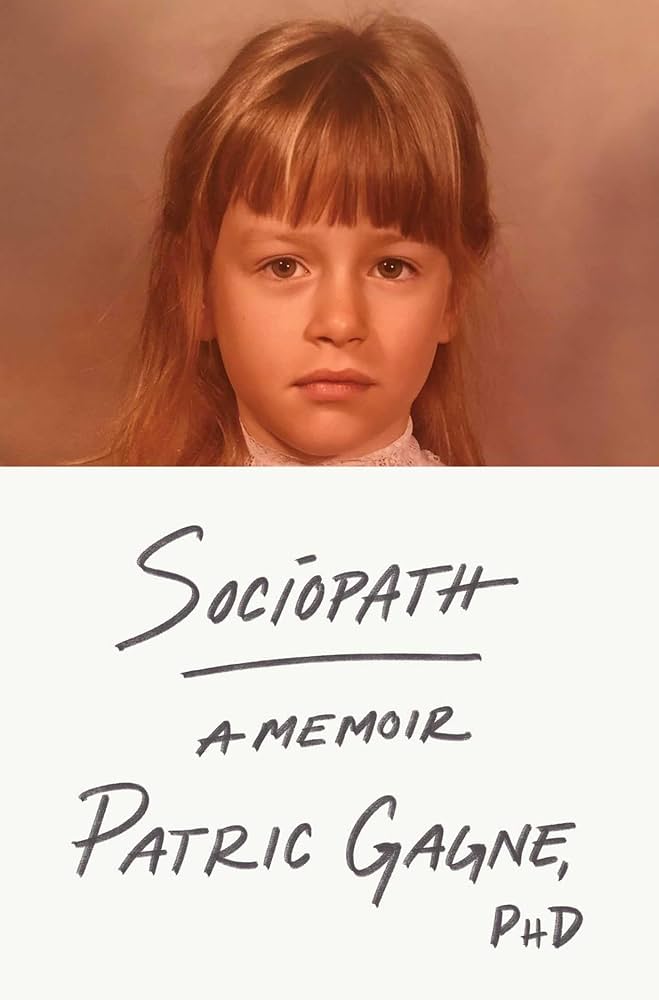
I’ve watched enough true crime to know that some people are wired to do very, VERY bad things—like torturing a small animal, then casually enjoying a happy meal. The fact that these humans exist creeps me out, and allegedly Patric Gagne is one of them. And boy is she happy to tell you all about it in her book, aptly titled “Sociopath.”
Before we get into this, I’ll warn you that we’re dealing with a highly unreliable narrator who wears her “HELLO! I’M A SOCIOPATH!” name badge with a bizarre sense of pride. This “memoir” was not what I expected, mainly because her stories just don’t add up, thus making me question whether she’s actually a sociopath. I have theories (*cough* narcissist *cough*), but I’ll leave it at that.
Here are my questions. If you have any insight, I would love to hear your thoughts!
Why is She So Proud of This Label? If I took a shot of whiskey every time she said, “I’m a sociopath,” I’d be wasted before reaching the second chapter. It baffles me how someone could easily latch onto this highly stigmatized diagnosis because it’s, well, creepy. I’m also baffled at how forthcoming she is with this information—even around her coworkers. Yikes. When she described herself as a “Wednesday Adams” breaking into houses with her pet ferret, things started to get clearer. She likes being different and edgy. Oh, don’t we all.
Does She Really Want to Go to Jail? I found it laughable when this extremely privileged girl claimed she wouldn’t mind going to jail because it would be more freeing. I sure wish she could’ve been caught just once while stealing cars so she could get a taste of that life. Little Miss Thang grew up in luxury, and she was hired at her daddy’s big-time Hollywood record label company without any experience. All this bravado about going to jail is just hilarious. Can someone please call her bluff the next time she breaks into a house?
So, Is She a Sociopath? It’s been fascinating reading the commentary by armchair psychologists in the Goodreads threads, but who am I to judge…or diagnose? However, I do question her motives, one being she’s way too eager to get that sociopath diagnosis, which eventually happens when she convinces her psychologist to administer some sort of test, which I’m sure she answered with a clear agenda. Why is this? Would another diagnosis (like..say..narcissistic personality disorder) be more mundane? Based on my honorary doctorate in forensic psychology (by way of murder podcasts), I know sociopaths just DO NOT CARE about having meaningful relationships. They also don’t give a fig about how they’re being perceived by others unless if there is something to be gained. Patic does, in fact, care. In social settings she is extremely self-conscious about not fitting in, but why? If she feels nothing for others, why does it matter? She expresses her love for her parents, her sister, and even her ferret. She’s also a mother and a wife, claiming she “feels a different type of love.” How does this make sense when you read through the classic symptoms of sociopathy in the DSM-5? Perhaps she’s right that so much is unknown about this diagnosis, but I still question her agenda.
Are These Stories Even True? I have a hard time believing that a 40-something can recant word-for-word conversations from her early childhood days. Some of these stories are so outlandish, they seem more like scenes from a bad Lifetime movie—particularly her altercations with a blackmailing schemer and a toxic coworker. Again, we’re dealing with an unreliable narrator who tells you in the opening chapter that she is manipulative AF, so all bets are off.
Are Her Credentials Legit? I’ll be honest; I haven’t done a deep dive into her academic history, but many others have. For someone who brandishes her Ph.D. title loud and proud on the cover, you’d think she’d talk a bit about her research on…oh, I don’t know…sociopathy??? Seems rather odd that she didn’t go there, but then again, she did confess that she’s a liar and a manipulator.
Overall Thoughts: This was a dark read, but not in a fun way. This felt like a waste of time because I wanted more expert knowledge about the innermost thoughts of a true sociopath. But all I got was a bunch of overindulgent drivel about the trials and tribulations of self-absorbed rich girl who wants SO BADLY to go against the mainstream. I have a hard time understanding how a sociopath can feel immense uncomfortable pressure from apathy. Is this really a thing? I can understand how sociopaths might struggle with isolation, but do they really ruminate about apathy?
Another question is why resort to bad things like stalking people, breaking into houses, and hurting precious kitty cats? Why not do adrenaline-junky stuff like jumping out of airplanes or running ultramarathons? It’s unsettling to think that some people can only get joy from doing dark things. Whether or not Patic is a true sociopath is anyone’s guess, but I am 100% convinced that she is creepy. My advice to anyone is to run far, far away when someone boasts about their dark personality disorder. Even if they’re not speaking the truth, keep running in the opposite direction!
 BUBBLE BUBBLE BOOKS & TROUBLE
Your review almost makes me want to read this book. I’m wondering if it’s all tongue and cheek by the writer? If not, one confident person that can confess it all and nothing happens to her because no one is sure if it’s true. That is the really scary part!
Man, you really brought any reservations I had about Gagne to the front. To be honest, I wanted to believe her because I’ve come to a point in my life where I’m tired of feeling guilty about things when I’ve tried to be the best I can be, and I was hoping that I could grab some insight or make connections. I was captivated by her story, and though I didn’t find it necessarily creepy, I couldn’t shake the feeling that this story might be some sort of ruse to get one over on people while gaining attention and some change $. I could see how a brilliant, narcissistic person could create a story and lie to embolden their true personality while increasing their bank account. It’s been done before. I hope that I’m wrong and her story is true because it did help me to understand how mind can work and that we don’t have to be subject to it, but I am wary.
This is one of the most bad-faith “reviews” I’ve seen in a while. I also consume a lot of true crime and that does NOT make one an expert in psychiatric conditions. If you actually knew psychological disorders, you’d know that Gange talks about herself in ways a narcissist never would. She constantly wondered what was wrong with her, something a narcissist does not do – they place the blame solely on others. She also desired to be left alone, to become invisible, things no narcisst wants, as they always want to be the center of attention and have people praising them or doting on them. The things you are interpreting as narcissism are actually just blunt, objective statements, because as a sociopath, Gagne is not concerned with speaking in the more humbling, indirect way that society expects us to. She’s not glamorizing her condition, she’s just being straightforward about it. Your description/overgeneralization of sociopaths is exactly why Gagne was writing this book: to offer a more nuanced, firsthand insight into the mind and experience of one. It must also be noted that the sociopaths who feature in true crime stories are the ones who did violent things and got caught – they represent a specific portion of sociopaths, but not all sociopaths, as there are many like Gagne who don’t commit horrible violent crimes. And if you were well-versed in psychiatric conditions, you’d know that “sociopathy” is actually part of the Antisocial Personality Disorder (APD) spectrum, emphasis on spectrum. Not everyone with the condition will present in exactly the same way (the same holds true for all psychiatric, developmental, and learning disorders). Just because Gagne does not present like the sociopaths featured in true crime stories does not mean she isn’t one. I also wonder how much of this book you actually read, because right there in the introduction she states “To be clear, I don’t want to minimize the severity of this disorder. Nor do I want to romanticize it. Sociopathy is a perilous mental condition, the symptoms, causes, and treatments for which need research and clinical attention. But this is precisely why I wanted to share my story: so individuals affected by sociopathy might receive the help they have needed for far too long.” This is the exact opposite of “claiming the label like a badge of honor”. She also does not state “I am a sociopath” over and over; she describes her experiences and what it’s like. In terms of her stating she thought being in prison might make her more free, you neglect to mention she had those thoughts AS A CHILD. Children, regardless of any mental disorders, will ALWAYS have severe misconceptions of things they have never experienced. Of course she was wrong about this. She is narrating the book from the perspective she had at the time. And if some stories seem like they don’t line up, A: She is recalling them to the best of her ability. She put a disclaimer at the beginning that not everything is going to be 100% accurate due to memory not being perfect, as well as deliberately condensing some things for the sake of not bogging down the book with too much detail; and B: You weren’t there. Regardless as to whether or not you find her stories plausible, you have no way to prove it one way or another. No one chooses to be a sociopath, or to have any other mental condition or disability. The desire to get a diagnosis stems from the fact that an official diagnosis opens the door to proper treatment. I went through the same thing with my ADHD. Yes, sociopathy is highly stigmatized, and understandably so, but the entire point of this book is to raise awareness and also show that, with proper understanding and treatment, sociopaths can still live relatively normal lives. The stigmatization (which you are contributing to with your ignorant comments) is a big part of what prevents treatment, coupled with the fact that many sociopaths don’t understand why they are experiencing things the way they do. Gagne is hoping that she can better educate people, sociopaths and non-sociopaths alike, so that others can find healthy ways of managing the condition. Yes, she is privileged in that she had a relatively good home life, as well as the cognitive capacity to be more introspective. Many sociopaths come from more impoverished conditions, have a less stable home life, and lack access to good education. The fact that she is female also likely helped; sociopathy is more common in males, who are also influenced by testosterone, as well as societal expectations towards male behavior (it’s generally more acceptable for men to be angry and violent, meaning they are less likely to be called out for it, especially as children. When young girls act that way, it’s seen as more unusual and concerning, and will therefore get adult intervention much quicker. AFAB individuals, on average, also tend to be more emotionally intelligent than AMAB people, meaning that even though she has a severe disconnect from most of her emotions, she is still able to understand them on a conceptual/intellectual level better than most sociopaths). You do not have to have liked the book, but your “review” is extremely ignorant and is only contributing to the problem. If you do not actually possess the qualifications to properly assess a mental condition as complex and serious as sociopathy, then you should not be making claims like this.
I felt exactly the same. And stopped reading in the middle. I would have continued if she had called it fiction. But I felt to betrayed. And bored. It is very repetetive on top. The same sentences and stories over and over again. And one more strange thing:Things like cell phones during her time at highschool, etc., but listening to a Walkman at the same time or stuff like that really irritated me. The lie is too obvious, but the success is weired. Greetings from Germany. I read a German copy of the book.
I think that some of the concepts are interesting. The idea that narcissism, sociopathy, and psychopathy are personality disorders on the same spectrum seems plausible. Also, we have probably all experienced the chaos that a narcissist creates, and the idea that it is done to feel an emotion seems plausible.
I do, however, find this book to be dangerous. It is dangerous for people (especially for women) who feel sorry for narcissists and struggle to set boundaries with people who behave this way. Narcissists will use people (as she does in the book), create every excuse in the book to get people to accept their behavior, and then discard the person (sometimes literally) when they no longer serve their purpose. They (as she does in this book) demand unwavering acceptance of their behavior without any attempt to get better. Calling it a personality TYPE is a huge problem that tries to manipulate people, as she does, into accepting them without boundaries. It screams….YOU JUST DON’T UNDERSTAND ME! She does this to both her mother and her boyfriend, and even to her therapist. At this point in the book, her mother is no longer in the picture. I suspect her mother didn’t serve her needs any longer. The therapist seems to be in over her head, but that again may be fiction. Sociopathy is a personality DISORDER, not just a type. Normal people do not get tempted to strangle a kitten to death.
Bottom line for me is that she makes NO attempt to learn to be compassionate but instead hides behind her “personality.” She mocks other people who are narcissists and calls them fauxpathy. Even while she is asking the reader to feel compassion for her personality, she is not attempting to feel compassion for anyone but herself. She claims that empathy is one of the “learned emotions.” I think that is debatable, but if she really thinks that, she could attempt to improve her empathy. If she had made this a book about how to learn to have empathy or how to teach people, it would be useful. As it is, I think it is very dangerous.
I wanted to see if someone would have criticism on the author’s book. We are in an age where “bad” behavior in women tends to be praised more then ever, so I don’t think it’s a bad thing to be wary of her claims. I’ve watched some of her interviews and though I find ur points valid, she seems self aware and articulates herself very well, so that I find her interviews and observations interesting and in a way inspiring. I do remember a female who kinda reminds me of her..that fraud scientist who claimed to have found a better way to do blood tests .. Elizabeth Holmes was her name. Her eyes and that very strong presence reminds me of her. It is a coincidence, but also the way she carries herself makes me think of how both women seem similar. Anyway, she is definitely branding herself well because she likes to identify as a sociopath and I feel like the attention seeking is more like narc behavior but yeah just my opinion. I find her fascinating despite that. No Ill intend, just observations, even if I am a bit critical. I hope her claims are true, so that we can better understand sociopathy. Because it is time we do know what causes people to be so addicted to dangerous behaviors and potentially harming others.
Thanks for you for your comment to my review! It’s so hard to tell what’s real in her book. The biggest red flag is her insistence on being labeled as a sociopath. She wants to own this so badly.