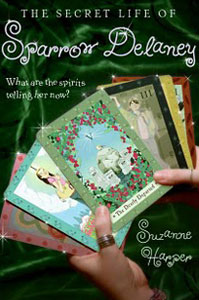
 As a contributing writer for ShelfLife@Texas, UT-Austin’s book blog site, I had the privilege of interviewing an up-and-coming young adult writer. If you’re a fan of Meg Cabot or Anne Brashares, you’ll love Suzanne Harper’s fun and frothy novels, “The Secret Life of Sparrow Delaney” (Harper Collins, 2008) and “The Juliet Club” (Harper Collins, 2008). [This blog is re-purposed from ShelfLife@Texas].
Did you set out to write fiction for young adults?
All through college and graduate school and many writing courses after that, I really wanted to write mysteries for the adult market, although I kept reading children’s books during that time simply because I enjoyed them so much. Then I started working at Disney Adventure magazine, which led me to learn more about children’s books and children’s publishing. Also during that time, the YA market started booming, so I found myself reading more books aimed at teens. Then one day I was doodling in my journal and found myself writing a sentence that would eventually become the first line of “The Secret Life of Sparrow Delaney” (“It’s three minutes past midnight and the dead won’t leave me alone”). As I kept writing, the voice of my main character came through loud and clear – and she was definitely a teenager! I started writing my first YA novel and found that it was great fun.
When you were a teen, what kind of books did you like to read?
I liked epic historical novels, gothic romance novels, comedic novels, mysteries, spy novels, fantasy and science fiction to  some degree….really, almost anything except moody books about mid-life crises (which I still avoid at all costs).
How do keep fresh when it comes to writing teen dialogue?
I don’t try to mimic teen speech as such. For one thing, slang dates a book really quickly. And for another thing, I think that if I were consciously trying to write teen dialogue – as opposed to trying to write good dialogue – I would quickly go off the rails. (I’ve read a few teen reviews online that complain that no teens actually talk like my characters, which is probably true. If anything, I guess I try to write idealized teen dialogue)!
In “The Juliet Club,” six friends are bonded by an organization called “the Juliet Club,” in which they answer letters sent to Juliet by those seeking advice on matters of the heart. What is the significance of the Shakespearean classic “Romeo and Juliet,” and why did you choose it to frame your story?
I read about the real-life Juliet Club, which is based in Verona, Italy, in an airline magazine. The club has dozens of volunteers who respond to letters from around the world, sent by people asking for advice from Juliet. (By the way, there is a nonfiction book about the history of the Juliet Club, which is the basis of the upcoming movie, “Letters to Juliet.”) I thought that the concept of the Juliet Club was a great setup for a YA novel, since Romeo and Juliet were teens and most teens first encounter Shakespeare through Romeo and Juliet.
Having said that, the main plot is really based on “Much Ado About Nothing.” It’s one of my favorite plays and it was great fun to re-visit it and echo certain scenes in the novel.
I also had a lot of fun researching the book. I visited Verona twice, took Italian lessons, and had tutors teach me a tiny bit about stage sword fighting and Elizabethan dance in order to write the scenes where my characters have to learn both those skills.
What message about love do you want the reader to walk away with?
That it’s a good idea to entertain the possibility that love will appear in disguise! In the novel, Giacomo thinks Kate is too studious and she thinks he’s too much of a flirt (actually, they’re both right, but they still fall in love). Silvia thinks Tom is awkward and gauche and Lucy doesn’t even notice Benno until almost the end of the book.
The other message is that love (and perhaps Shakespeare– or maybe both!) can transform people. Kate learns to flirt, Giacomo truly falls in love for the first time, Silvia softens a bit, Tom finds courage to declare his love, and so on. (And let’s not forget Kate’s father and Giacomo’s mother, who overcome a bitter academic rivalry to find romance).
In “The Secret Life of Sparrow Delaney,” the protagonist is a teenage medium who tries desperately to be “normal.” How do you think your readers can identify with Sparrow?
I think the desire to be normal and fit in is a classic teen wish, mainly because almost every teenager (even the popular, “normal” ones) secretly feel that they’re weird and abnormal. Also, teens are very self-conscious about being teased or seen as different, so most of them can identify with the fear of being mocked because their family talks to ghosts (even if their family doesn’t).
Paranormal young adult novels have become a huge hit among teenage girls. Why do you think young readers are so enthralled by things that go bump in the night?
Teens have always been fascinated with death and the possibility of an afterlife. I think it’s because they’re still relatively close to that shocking moment in childhood when you first realize that people you love — and eventually you — will die. It’s a subject that fascinates and scares them in equal measure, and they like reading books that address those issues.
Can you give us a glimpse into what you’re working on now?
I’m working on a middle grade series, which again involves the paranormal (and is set in Austin). I also have another YA novel in progress that is set in an alternate version of 18th century England and involves a troupe of traveling players.
About the Author: Harper has written three original novels based on the “Hannah Montana” TV series and a number of novels (under the pen name N. B. Grace) based on “High School Musical.” Her nonfiction books include “Boitano’s Edge: Inside the Real World of Figure Skating” (with Olympic gold medalist Brian Boitano), “The Real Spy’s Guide to Becoming a Spy” (with Peter Earnest, executive director of the International Spy Museum), “Terrorists, Tornadoes and Tsunamis: How to Prepare for Life’s Danger Zones” (with Lt. Col. John C. Orndorff), and “Hands On! 33 More Things Every Girl Should Know: Skills for Living Your Life from 33 Extraordinary Women.” Visit her Web site for more about her works.

 Leave it to Mary Higgins Clark, known by her steadfast readers as the “Queen of Suspense,” to craft an intricate mystery, chock-full of shady murder suspects, lies and deceit.

 BUBBLE BUBBLE BOOKS & TROUBLE